

Last Updated on January 21, 2026
Out of all my trips around the world, planning out a memorable Scotland itinerary was one of the most riveting, exciting, and cherished 10 days that I’ve had. Scotland is a place where Harry Potter fans, history lovers, nature lovers, and city lovers all come together in this melting pot of a country.
A Scotland road trip through alluring Edinburgh, the lush green tones of the Scottish Highlands, and destinations with rich history like Mary King’s Close, Eilean Donan Castle, and Loch Ness will leave you in awe of just off under the radar this place is compared to other road trip destinations.
This 10-day itinerary covers all the main highlights of central and northern Scotland, as well as all the best areas of the west coast. There will be no stone unturned and you can mold this itinerary to best suit your needs and interests.
You’ll quickly find that you can explore a myriad of interests all across the country. One day I cannot wait to return to this magical place with my own rental car and the open road. There are few things better than that!
I have poured so much love into curating all the best stops on this 10 day Scotland itinerary to get your exploration on! Let’s get started, shall we?
IMPORTANT NOTE: As of 2025, travelers who do not need a visa to travel to the UK (that includes Scotland) will have to apply for an ETA (electronic travel authorization) before traveling. The UK ETA will cost £10 and be valid for 2 years. Travelers from the US, Canada, Australia, and other countries will need an ETA starting on January 8, 2025, while the ETA requirement will go into effect for EU countries in March 2025. Applications can take 3 or more days to process, so give yourself enough time before a trip. You can find more info here.
Please note that some links on my blog are affiliate links. If you choose to purchase through these links, I may receive a small commission at no extra cost to you. When What Do You Sea is supported in this way, you are helping me remain an independent travel blog where I can continue to create free and detailed guides. Read my full disclosure for more information.
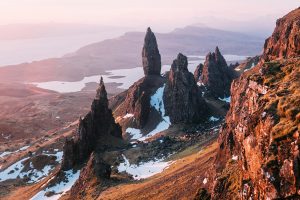
Things To Know Before Visiting Scotland
It’s pronounced “eh-din-bur-uh”, not “ed-in-burg”. I may or may not have found this out from personal experience… Locally, it’s often reduced to “Edin-bru” or even “Embra”.
Know the stories. While the magic of Scotland is a statement all on its own, there are many places that are magnified when you know the stories behind them. If you do a little bit of homework about the destinations you’ll be visiting, you’ll appreciate them so much more.
Check the current exchange rate. Scotland uses pounds as its form of currency, like the rest of the UK, so compare it against your local currency for the most up-to-date rates. Check rates
Take advantage of daylight hours. Often in high season, Scotland experiences 12+ hours of daylight, which gives you ample opportunities to wake up early and ditch the crowds. Put that time change to good use. You won’t regret it.
Keep left. They drive on the left side of the road in Scotland, which also translates to the rules of the sidewalk.
Bring comfortable walking shoes. While atmospheric, the cobblestone cities don’t do your back any favors.
Book everything in advance. Any time of year, but especially if you’re visiting during the summer. If you wait, you’ll get the last draft pick of just about everything: tours, accommodation, and rentals.
Pack a good raincoat. The weather in Scotland is known for changing on a whim and the city is no stranger to spontaneous rain. A good raincoat will keep you dry and prevent you from wasting your pint money on a cheap tartan umbrella…
Learn some local jargon. While wandering and interacting with locals, you’ll hear many things that may have you scratching your head. When asked if I was in the “queue” (the line), I looked confused for about five seconds before I realized what I was being asked. Here are some popular words to know:
Scran = food
Queue = waiting line
Loch = lake
Dram = a shot of whisky
Kirk = church
Law = hill
Tipping isn’t as common. It’s generally only required for table service at a restaurant (around 10-15%).
10 Day Scotland Itinerary
This Scotland itinerary focuses on four main areas that are the most popular locations in Scotland: Edinburgh, the Scottish Highlands, Isle of Skye, and Glasgow.
The days are divided up by region. You’ll spend ten days exploring two of Scotland’s historic cities, stand in awe at views over Glencoe Valley, and get a first-hand look at what Scotland’s nature does best: show off.
I have advice and tips throughout this itinerary so you can cater to your travel style and interests. Don’t miss the list of more things to do in Scotland at the end of this blog post for more options to tweak this itinerary further.
Who this itinerary is for | This itinerary is perfect for first-time travelers to Scotland who are looking to hit all the major sites, with the opportunity to get off the beaten path. It’s best suited for nature lovers who love a good hike, good food, and a healthy mix of city and nature.
Use this map to help you navigate this 10 day Scotland itinerary! For best use, download this map to your smartphone so you can use it offline (instructions here).
Day 1 | Edinburgh
Your first day in Scotland is your chance to see a few of the main highlights of this enchanting city after landing off your red-eye flight.
Today is the day you’ll be settling into where you’re staying for the night, so feeling sluggish or tired is highly likely. Whenever you land, head to where you’re staying, get a quick nap in, and you’ll have a boost to go and get familiar with the city.
Start things slow with an afternoon tea experience, then spend the day getting familiar with the Royal Mile and Grassmarket Square.
Afternoon Tea
The best way to start exploring without overdoing it is by going to an afternoon tea experience. This is great since it’s normally hosted in the early afternoon, which gives you time to settle in if you’re coming off an early morning flight.
Clarinda’s Tea Room is an adorable and casual tearoom along the East end of the Royal Mile. The Witchery is all about atmosphere and is reminiscent of a Gothic bygone era. For something more refined (pinkies-out, white tablecloth kind of vibe), The Dome and Palm Court inside the Balmoral are legendary. Clarinda’s doesn’t take reservations, but definitely make them in advance for the other three.
After filling up on that plate of goodies, you’ll set out to the Royal Mile to get some light exploring in for the day.
The Royal Mile
Every time you walk the Royal Mile, you see something new. This historic street in the heart of Edinburgh dates back to the 12th century, when Edinburgh was just a small town. Known as High Street, this road connected the castle to the town. It’s the spine of Edinburgh’s Old Town, and connects the city’s most important landmarks.
The Royal Mile is plagued by overtourism, but because of its history, it’s easy to understand why tourists flock to this historic epicenter. Regardless, it’s a must-see while you’re in Edinburgh.
There are many notable things to see here:
/ / The Real Mary King’s Close: A maze of hidden streets below the city where people lived, worked, and died between the 17th and 19th centuries. The best way to see it is on a guided tour where you can learn the history of the people here, its reputation for hauntings, and all about the Black Plague.
/ / The Witchery by the Castle: One of the only shops on the Royal Mile where you can get quality, Scottish souvenirs like handmade leather goods and woven textiles made in Scotland. Every item has a story and is from a local Scottish artist.
/ / St. Giles Cathedral: This is a monumental piece of Gothic architecture founded in the 12th century by King David I. For over 900 years, it’s been a running Angelic parish church. There are over one hundred memorials lining the walls, plus stunning archways and stained glass. It’s free to walk inside and they also have free guided tours at 10:30 a.m. and 2:30 p.m., but they need to be booked in advance. Find booking links under the “Guided Walking Tours” section.
/ / John Knox House: The oldest, original medieval building that has survived on the Royal Mile. It’s associated with one of the most dramatic and turbulent times in Scottish History, the Scottish Reformation, when Scotland separated from the Catholic Church and formed its own Protestant Church of Scotland. It’s since been preserved and now operates as a small museum. An entrance ticket is £7.
/ / The National Museum of Scotland: One of my favorite museums in the world. Don’t miss the Millennium Clock, Window on the World, Skull of Moby the Whale, Arthur’s Seat Coffins, The Maiden, Witch’s Iron Collar, and Dolly the Sheep! It’s free to visit the museum, but donations are encouraged to go towards the exhibits and future exhibitions.
/ / Scottish Portrait Gallery: This stunning red-stone portrait gallery is eye-catching all on its own, but a must for one of the best chronological histories of Scotland told through artwork. Don’t miss the Zodiac ceiling inside the world-famous Great Hall! Admission is free.
/ / Tipsy Midgie: This whisky bar near the Royal Mile is a better bang for your buck than the Scotch Whisky Experience and some other tourist trap experiences in the area. They host whisky and chocolate tastings for novice drinkers and whisky die-hards.
/ / The Writer’s Museum: A 17th-century house that features manuscripts and personal items of some of Scotland’s most famous writers, like Sir Walter Scott. Even if you don’t go into the museum, Lady Stairs Close, which leads to the museum, is worth a look on its own.
Grassmarket Square
Grassmarket Square has lived in the shadow of Edinburgh Castle for over 500 years, operating as a bustling marketplace and witness to centuries of Scottish history, from riots and even executions. Today, it’s recognized as a UNESCO World Heritage Site.
By the turn of the 20th century, it became known as Edinburgh’s “Little Italy” due to the influx of Italian immigrants in the 1880s. You’ll see a lot of Italian tradition here with sunny patios, restaurants, and vibrant shops. The shops here have much more soul than those on the Royal Mile, so do a little window shopping here as well before you decide on souvenirs.
/ / Armchair Books: THE spot for book lovers. This is an adorable, family-run bookshop with titles crammed into every nook and cranny of this place. Oozes charm!
/ / Armstrong’s Vintage: A thrift store that opened in 1840 and now sells women’s and men’s clothing through the decades.
/ / Greyfriar’s Kirkyard: This cemetery is popular for two reasons: it’s a beloved location for Harry Potter lovers since many tombs inspired names in Harry Potter, like Thomas Riddle and Elizabeth Moodie. The second is that it’s the burial place of Greyfriar’s Bobby, a 19th-century Skye terrier said to have sat by his owner’s grave for 14 years until he passed. A lot of people know the story and will go rub the nose of the Greyfriar’s Bobby Staue nearby, but it’s really just a kitschy tourist thing and Edinburgh officials have been pleading with tourists to stop rubbing it. Instead, lay a stick at the gravesite.
/ / Edinburgh Farmer’s Market: A weekend-only staple to discover local cuisine and products right beneath Edinburgh Castle. Come hungry because there are a ton of local vendors selling produce and all different types of cuisines.
/ / Victoria’s Street: The most famous street in Edinburgh that was allegedly one of the inspirations for Diagon Alley in Harry Potter. Lined with shops and cafes.
/ / The Elephant House: The original location of this cafe was devastated in a fire, so there is a new location while the old one is being repaired. The original is rumored to be the birthplace of Harry Potter, but let’s be real you already knew that.
/ / The Vennel Viewpoint: An iconic photo opportunity of Edinburgh Castle. Don’t miss!
Where to Stay in Edinburgh
With only a couple of days in Edinburgh, stay in the Old Town or the New Town. Kick Ass Grassmarket is a lively, budget-friendly hostel in the heart of it all. Six Brunton Place is a charming and historic bed and breakfast in a quiet neighborhood. Virgin Hotels Edinburgh is a beautiful hotel and the rooftop bar has a stunning view over the city. If you can, splurge on The Witchery. Still searching? Look for places on and around the Royal Mile.
Places to Eat in Edinburgh
Grab a pint at the Sheep Heid Inn, said to be the oldest surviving pub in Scotland. Dishoom is a famous Indian restaurant for good reason. David Bann is a staple if you’re vegetarian or vegan. The Milkman off Cockburn Street is plotted on some fine real estate for photos. Visit Black Medicine Coffee Co. for more good brews. The Edinburgh Larder is THE spot for a full Scottish breakfast (go to BBL for a veggie option). For dinner, make reservations at the teeny tiny Skua, whose menu is a love letter to modern Scottish cuisine.
Day one at a glance
What to book | Your afternoon tea reservation, any museums or tickets, and your accommodation in Edinburgh.
/ Arrive in Edinburgh
/ Settle into your accommodation
/ Have an afternoon tea experience (make a reservation if needed)
/ Explore the Royal Mile
/ Wander around Grassmarket Street
Day 2 | Edinburgh
The second day of this 10 day Scotland itinerary is jam-packed with the city’s most significant cultural sites. I hope you brought walking shoes for all this cobblestone.
Start the day at Edinburgh Castle to avoid peak crowds, then make your way to the Scott Monument, where you can learn the history of famous Scottish writer Sir Walter Scott. Walk up Calton Hill for a stunning view of the city before making your way to the Palace of Holyroodhouse and Holyrood Abbey.
End day two with a stellar sunset atop Arthur’s Seat.
Edinburgh Castle
Edinburgh Castle is the centerpiece of the city and Scottish history. This stronghold was built in 1103 and throughout that time has been a royal residence, military fortress, prison of war, and the most besieged castle in Great Britain.
It’s full of Scotland’s stories and a must-see while you’re here. There’s not technically a wrong way to visit, but some kind of audio tour or guide it essential, and that’s why I recommend a guided walking tour, because the castle grounds are massive, and it would take you weeks, even months, to see everything thoroughly.
Another option is to pick up an audio tour on the castle grounds for a few more pounds, but I’ll tell ya, it’s a bit of a snooze fest just because of the sheer amount of information they pack into it.
Tickets absolutely must be purchased in advance. Book the earliest available timeslot because the castle grounds get PACKED almost as soon as it opens.
What to see on the castle grounds: St. Margaret’s Chapel, The Crown Jewels, One o’clock Gun, the Great Hall, and the Prisons of War.
Address: Google Maps | Website: Edinburgh Castle | Cost: £21.50 ($29) for adults; £13 ($18) for children 7-15; Free for children under 7
Scott Monument
The next stop is the Scott Monument, a massive Victorian Gothic structure that defines Edinburgh’s skyline and is a tribute to Sir Walter Scott. He was a Scottish novelist and poet who many say rewrote the nation of Scotland during the nineteenth century.
This monument is the largest dedicated to a writer anywhere in the world, and with tickets, you’ll join a tour guide who will tell you all about who he was, his legacy, and why this was built in his honor.
You can go inside the monument and climb four different viewing platforms to the very top to see one of the top views overlooking Princes Street, the Princes Street Gardens, Old Town, New Town, Edinburgh Castle, and the Firth of Forth.
Good to know: The monument closes every day from 12:30 p.m. to 1:45 p.m. for lunch, and the last tours are at 3:30 p.m.
Tickets can not be prebooked and must be purchased at the kiosk on arrival.
Address: Google Maps | Website: Scott Monument | Cost: £9 ($12) for adults; £7 ($9.50) for children
Calton Hill
If you didn’t know already, Edinburgh is also known as the City of Seven Hills, and Calton Hill is one of them. It’s just a short walk east from the Scott Monument, so recaffeinate at Artisan Roast if you need, or grab a bite at Valvona & Crolla for some quick, but authentic Italian food. You’ll need it for the short slog up the hill.
Around the early 19th century, Edinburgh was named the “Athens of the North,” and Calton Hill was Scotland’s version of the Acropolis. Also, it’s another UNESCO World Heritage Site. At the top, there are many notable monuments that serve as a kind of open-air gallery with panoramic views of the city.
The Nelson Monument is the most photographed with a backdrop of the city, but peruse around and see the Dugald Stewart Monument, Collective Art Gallery, the Nelson Monument, and the Monument to the Scottish Parliament.
Address: Google Maps (entry steps linked) | Website: Calton Hill | Cost: Free
Palace of Holyroodhouse & Holyrood Abbey
The Palace of Holyroodhouse is the epicenter of Scottish Royal History and the official residence of the King when carrying out affairs in Scotland.
Good to know: The Palace is not open for tours when the King is in Scotland.
Apart from the current monarchy, the Palace is associated with important figures in Scottish royal history like Mary, Queen of Scots, and Bonnie Prince Charlie. Highlights are the Throne Room, Great Gallery, Palace Gardens, the Great Stair, and the King’s Gallery.
There are all sorts of artwork here and always an interesting exhibition or two on rotation. After exploring the inside, go out back to see Holyrood Abbey, the remains of an abbey from 1128.
Book your tickets in advance and you can save a few pounds. All ticket sales come with a media guide to complete your tour.
Address: Google Maps | Website: Palace of Holyroodhouse | Cost: £21 ($29) for adults; £13.50 ($18) for young people (18-24); £10.50 ($14) for children
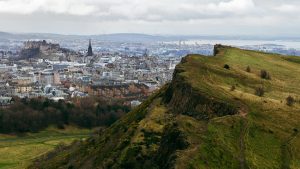
Arthur’s Seat
THE sunset spot in Edinburgh is Arthur’s Seat.
It’s another one of Edinburgh’s seven hills (this one is an ancient extinct volcano!), and there are a variety of ways to get to the top. The best way is right across the street from the Palace of Holyrood, where Margaret’s Well is. On your way up, take the spur trail up to St. Anthony’s Chapel Ruins, then continue to the top of Arthur’s Seat.
This is no casual stroll, so make sure you wear the proper footwear and layered clothing. At the top, it’s extremely windy and much colder than the rest of the city, so pack things to keep warm, even in summer.
In total, it’s around 1.1 miles to the very top of Arthur’s Seat. Due to the incline, it could take up to an hour for you to get to the top depending on your fitness levels. The trails are well worn, and there will be plenty of people, so you won’t get lost, but you can get walking directions on Google Maps.
Day two at a glance
What to book | Edinburgh Castle tickets, Palace of Holyroodhouse tickets, and accommodation in Edinburgh.
/ Dive into history at Edinburgh Castle
/ Enjoy the views from the Scott Monument
/ Hike to the top of Calton Hill
/ Feel like royalty at the Palace of Holyroodhouse & Holyrood Abbey
/ Arthur’s Seat for sunset
Day 3 | Edinburgh to Isle of Skye
The bulk of the third day is going to be driving from Edinburgh to the Isle of Skye. Depending on the time of day you leave, you may have time to squeeze in stuff along the route, which I’ve listed below. Read my complete guide to getting from Edinburgh to the Isle of Skye for more in-depth details on the drive and transport options.
Tonight, you’ll end in Skye’s capital city, Portree.
How To Get To The Isle of Skye
There are two routes to get to the Isle of Skye, and you’ll use both during this itinerary. For the drive up, take the northern route through Inverness (get driving directions), and on the way back, take the south route through Fort William and Glencoe Valley (get driving directions).
You can expect the drive to take around five hours total, and maybe longer if you choose to stop more along the route. Leave early to give yourself enough time for everything.
The roads, albeit small, are well-maintained throughout, so you don’t need any special type of rental car to get to the Isle of Skye.
Good to know: If you don’t feel comfortable doing a self-drive tour of Skye, endless multi-day tours leave from Edinburgh daily. They feature many of the same stops here, but without the headache of driving. Depending on your travel style and budget, it could be a better option for some.

Edinburgh to Skye Route Highlights
For a lot of these stops, knowing the history behind them is crucial to appreciate them properly.
When I visited Culloden Battlefield, I didn’t know anything about the Jacobite Rising, so it didn’t impact me in ways it could have. A simple castle visit can turn into stories of kings, bishops, battles, and royalty if you do a little research beforehand. Highly recommend.
/ / Stirling Castle | One of the largest, most significant castles in Scotland, where multiple kings and queens were crowned, including Mary Queen of Scots in 1542.
/ / Pitlochry | An adorable small village for bathroom breaks, snacks, and other last-minute road trip essentials. It’s also home to Scotland’s smallest whisky distillery, Edradour.
/ / Loch Ness + Urquhart Castle | A 23-mile long lake home to Nessie, the Loch Ness monster, and a historic castle built alongside it.
/ / Portree | The capital and largest town on the Isle of Skye, where you’ll stay the night tonight.
Choose a handful of these to include during your drive up. Stirling Castle, Loch Ness, and Eilean Donan Castle are some of the must-sees.
Where To Stay In Portree
Portree is a very common base camp for exploring the Isle of Skye, so there are many really nice places to stay here, just make sure you book these months in advance because they get booked up FAST. Also, Portree is the most touristy town, and if you want to steer clear from that, look at places in Skeabost and Penifiler.
The Storr Apartments are for anyone who wants to think, “I could live here” during their trip. The views and aesthetics go on for miles at the Cuillin Hills Hotel, and the Skeabost View Pods Skye take you into Portree’s countryside for total privacy. If you can sacrifice some comforts for an attractive price, stay at the Portree Youth Hostel over the other one in town.
Places to Eat in Portree
Sea Breezes is a must for freshly caught seafood on the harbor, as is Scorrybreac Restaurant. In the morning, try Birch Cafe or The Highland Cow Shop. On your way to Portree, stop at Lean To Coffee and Manuela’s Wee Bakery for a pick-me-up.
Day three at a glance
What to book | Accommodation in Portree, dinner reservations in Portree, and any in-advance castle tickets.
/ Stirling Castle
/ Pitlochry
/ Loch Ness
/ Urquhart Castle
/ Dinner in Portree (make a reservation)
Day 4 | Isle of Skye
The Isle of Skye is the most well-known of all the Scottish Isles, and it’s a must-see for anyone visiting Scotland for the first time.
It’s known for its rugged beauty and verdant rolling hills, and for the next three days, you’ll be visiting the highlights and off-beat things to do around the island. For more ideas, read my guide to the Best Things To Do in The Isle of Skye (coming soon).
Your first full day on the Isle of Skye will be spent driving the Trotternish Peninsula. It’s the northernmost peninsula of Skye and takes about 1.5 hours to drive the entire loop without stops.
Even though it’s the most touristy part of Skye, there are places absolutely worth stopping for despite the crowds. As long as you leave early and stay out a bit later, you’ll get some reprieve from the tourists, but if you’re visiting in peak season, don’t expect to have much to yourself here.
/ / The Quiraing | This is one of Skye’s most epic preserved nature areas with a small network of hiking trails that boast huge reward. The best one is a 4.5-mile loop trail that takes you up and over the pinnacles to the best views of the area. It takes about two hours to complete the entire thing.
Good to know: You pass Kilt Rock and Mealt Falls on the way to the Quiraing, but you won’t regret minimal backtracking to see the Quiraing for a sunrise mission.
/ / Kilt Rock & Mealt Falls | A dramatic basalt cliffside that resembles the pleats of a kilt features a single drop waterfall into the ocean below. The car park takes you right up to the falls, but if you want to view it from afar (with zero crowds), hike to Brother’s Point instead.
/ / Duntulm Castle (optional) | This is the crumbling and shattering old stronghold of the Clan MacDonald. Built during the 14th or 15th century, this castle was the centerpiece of the feuds between the MacDonald and MacLeod Clans, and was abandoned around the 1730s. This castle doesn’t have any supplemental information, so do a bit of reading before you go. If you aren’t into history, you can skip this because it’ll be underwhelming.
/ / Rubha Hunish | This is an expansive viewpoint where you can see the very top of the Trotternish Peninsula with views of Duntulm Castle and an old bothy that was used by the Scottish coastguard for whale spotting. Wildlife spotting is common in this area, so bring binoculars if you have them (and rain gear!).
/ / Skye Museum of Island Life (optional) | An old Highland village that has been converted into a museum. It gives true insight into the island over 100 years ago through personal artifacts, documents, and photographs.
/ / The Fairy Glen | An otherworldly hillside where small stones are placed in enchanting patterns. While there isn’t any folklore attached to this location, the unusual landscape formation makes you believe otherwise.
Places to Eat on the Trotternish Peninsula
There are only a handful of places serving food along the loop, so you’ll want to pack additional snacks for the drive. Bûrr serves takeaway coffee and cakes near Duntulm Castle. The Hungry Gull serves a full cafe menu to refuel after the Quiraing, and The Galley Cafe & Takeaway is perfect for chips and a pint near the Fairy Glen.
Day four at a glance
/ Breakfast at your accommodation
/ Enjoy the sunrise at The Quiraing
/ See Kilted Rock + Mealt Falls
/ Hike to Brother’s Point for more views
/ See the Duntulm Castle ruins (optional)
/ Hike to Rubha Hunish
/ Go back in time at the Skye Museum of Island Life (optional)
/ Feel the magic at The Fairy Glen
/ Wind down in Portree
Day 5 | Isle of Skye
The second full day on the Isle of Skye will be spent roadtripping out to the eastern edges of the island to see an atmospheric lighthouse, a fairytale castle, and iconic fairy pools. We prioritized sunrise at The Quiraing yesterday so that this morning we can hike to the Old Man of Storr with the best views and fewer crowds. On the way, make a quick stop at Bride’s Veil Falls.
Things get a little more remote on this day of the itinerary, so use my free map at the beginning of this blog post to scope out places to stop and eat along the route. If needed, stock up on more snacks at the market in Portree.
Bride’s Veil Falls
This cascading, multi-tiered waterfall, a tributary of nearby Loch Leathan, puts on quite a show.
It’s a quick stop before heading to the Storr, so stop and smell the roses, then continue a bit further up the road. The waterfall is right off the main road, so there are only a handful of parking spots available. Since you’re getting there early, there should be space to pull off.
Address: Google Maps | Cost: Free
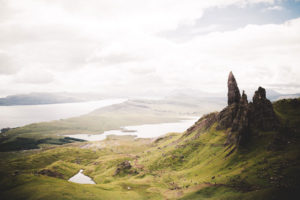
Old Man of Storr
The Old Man of Storr is Skye’s postcard landmark, whose hiking trail takes you through some seriously otherworldly landscapes. It’s without a doubt one of the best hikes in Scotland.
Three massive stone monoliths tower over verdant green hills. It may look familiar as it’s been a filming location in many iconic movies, like Prometheus. When you get to the top, be sure to explore around the rock formations to get better angles and views.
It’s a short hike, but steep, so bring proper hiking shoes and read my guide for hiking the Old Man of Storr trail to know exactly what to expect.
Address: Google Maps | Cost: Free
Coral Beach
Scotland may not be known for its beaches globally, but there is plenty of white sand to go around at Coral Beach.
Year-round, the waters are chilly in Scotland, so take a dip if you dare, but this is a perfect place to stop and have a picnic lunch. On sunny days, the shores resemble the turquoise waters along the Mediterranean Sea.
If you get lucky, you may see some cows along the shore!
Address: Google Maps | Cost: Free
Dunvegan Castle
Dunvegan Castle is one of the most spectacular Hebridean Castles in the Scottish Highlands, and this one has been the ancestral home of the Chiefs of clan MacLeod for more than 800 years.
Good to know: The castle is only open from April 1st to October 15th.
Inside is a trove of architectural works and preserved artifacts dating back to the 13th century. You can purchase tickets to tour the castle and gardens, but if you want to skip and admire from afar, there is an area here where you can pull off and see the castle against Skye’s verdant backdrop.
If you’re interested, the castle also offers seal trips, which take you to see the loch’s cheeky seal colony. It’s only a short 25-minute boat ride out there, so if you skip the castle tour, this is a great supplemental activity.
Address: Google Maps | Website: Deunvegan Castle | Cost: £17 ($23) for adults; £12 ($16) for children 5-15
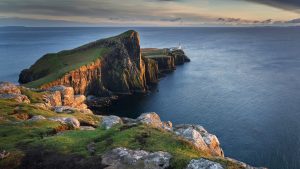
Neist Point Lighthouse
Neist Point is one of the most famous lighthouses in Scotland.
It’s situated on the easternmost edge of the Isle of Skye atop a dramatic peninsula. Framed by the Atlantic Ocean, it makes a beautiful stop for pictures.
There is a one-way path you can take all the way down to the sea cliffs and near the lighthouse if you choose. It should take around 45 minutes total, or you can snap a photo at this viewpoint, take in the view, and be on your way to the next stop.
Address: Google Maps | Cost: Free
Day five at a glance
/ Breakfast at your accommodation
/ A quick stop at Bride’s Veil Falls
/ Hike the Old Man of Storr
/ Relax at Coral Beach
/ See Dunvegan Castle
/ Capture the Neist Point Lighthouse
/ Dinner at The Three Chimneys or Edinbane Lodge (make reservations in advance)
/ Portree
Day 6 | Isle of Skye to Glencoe
On your last day in the Isle of Skye, you’ll make a few obligatory stops before driving to Glencoe Valley.
Driving from Skye to Glencoe takes about three hours, beginning from the Fairy Pools, so you can take this day as easily as you’d like, depending on whether you want to go hiking in Glencoe Valley this afternoon.
The Coffee Bothy and Lean To Coffee are both on the way for a pick-me-up just before you leave Skye and get back onto the A87.
The Fairy Pools
The Fairy Pools are one of the most famous things to see on the Isle of Skye. They’re a series of small waterfalls and pools that flow down from the Cuillin Mountains, and because the water is so pure, you can see to the bottom of the pools.
Many legends about fairies are associated with the pool. Some talk about them being home to the Blue Men of the Minch, a group of mythical creatures who draw sailors to their deaths, and some believe that these pools are a gateway to the fairy realm. Although you’ll likely hear many more than just these.
The hike to get to them is about 2.3 miles round-trip and takes a little more than an hour to complete.
If you’re brave, the Fairy Pools are one of the best places in Scotland for wild swimming, but be prepared to brace the cold.
Address: Google Maps | Cost: Free
Sligachan Old Bridge
On your way out of Skye, make a quick stop at the Sligachan Old Bridge, a historic landmark built in the early 1900s, over waters believed to flow with the key to eternal beauty.
The stories around the bridge surround Scotland’s greatest warrior, a legendary female fighter by the name of Scáthach, who lived on the Isle of Skye. She was an expert in warfare, and warriors came to train with her at present-day Dunscaith Castle. Word of her talents spread across the sea to Ireland, and Cú Chulainn wasn’t pleased.
The Irish demigod sailed to Dunscaith to challenge Scáthach, and they battled for days. Uathach, Scáthach’s daughter, began to grow worried for her mother and pleaded to the fairies beneath the bridge to help her. The fairie queen told her to wash her face in the river, and she’d know what to do.
After doing so, she knew she needed to prepare a feast with the richest ingredients and finest spices to lure both warriors to a temporary truce as they regained their strength. The two broke bread together, and Cú Chulainn realized he was now a guest in Scáthach’s home, forbidding him to battle with her. The battle was accepted as a draw, and bits of Uathach’s magic are said to be left in the river.
If you believe the legends, to get eternal beauty, one must fully submerge their face in the water beneath the bridge for seven seconds. Afterward, you have to let the water dry naturally and cannot wipe it off, otherwise, the fairies won’t grant you the eternal beauty.
Address: Google Maps | Cost: Free

Eilean Donan Castle
Eilean Donan is one of the most recognizable castles in Scotland. It’s perched on a tiny island where three lochs meet and features a long stone bridge that leads one to its weathered walls.
It arose in the 13th century to help evade Viking raids, and its history is shrouded in legends. Inside holds period furniture, family portraits, a Coat of Arms associated with the Clan MacRae, Jacobean relics, and weaponry displays, but admiring from the outside is just as good if you don’t feel like doing another castle tour.
Nearby is Manuela’s Wee Bakery if you need a pick-me-up before getting back on the road to Glencoe.
Address: Google Maps | Website: Eilean Donan Castle | Cost:£12 ($16) for adults; £6.50 ($9) for children over 5
Glencoe
Glencoe is a historic village surrounded by some of the Highlands’ most iconic mountains and marked by a sorrowful past, including the Jacobite Rising. It’s an epicenter for hikers and climbers, and a must-see on any 10-day Scotland itinerary.
There are hiking trails here for all levels, and since you’re getting here in the afternoon, here are the shorter trails you should consider:
/ / An Torr Circuit | An easy, 1.2-mile loop trail with views that feature a flowing river and surrounding mountains.
/ / Glencoe Lochan | A moderate, 1.5-mile loop with a variety of trails near Loch Laven. It feels like you’re walking through a small slice of the Pacific Northwest right in the heart of Scotland.
/ / Coire Gabhail (Lost Valley) | This moderate to difficult 2.5-mile out-and-back trail takes you up through a picturesque valley in the heart of Glencoe.
/ / Fairy Glen of Glen Creran | A short and serene 2.5-mile walk to a waterfall and storybook fairy bridge.
/ / Hagrid’s Hut | This is a short walk off of Glencoe Studio Gallery Road, and you can find parking at the Clachaig Inn. It’s where they built Hagrid’s Hut for the filming of Harry Potter. The hut is no longer there, but you can catch the ambiance when you’re there.
Address: Google Maps | Cost: Free
Where To Stay In Glencoe
Glencoe offers many historical and unique places to stay for you to unwind after exploring the valley. The Ballachulish Hotel is baronial style at the foot of the mountains. If you’re looking for a quiet stay on Loch Leven, The Boathouse is the best option if you want to stay somewhere unique and if you’re traveling as a couple. For something more budget-friendly, the Glencoe Youth Hostel is a great stay in an ideal location near the Glencoe Visitor’s Center.
Places to Eat in Glencoe
Moss is an unassuming restaurant in the heart of town serving seasonal plates and local produce. Stiff Peaks Patisserie has all the coffee and baked goods you’ll ever want. Restock snacks and hiking food at Ballachullish Co-op. Cuil Seafood serves fresh-as-you-can-get hot and cold plates out of a vintage van.
Day six at a glance
/ Breakfast in Portree
/ Take a dip in The Fairy Pools
/ Quick stop at the Sligachan Old Bridge
/ Let Eilean Donan Castle inspire you
/ Have a pick-me-up at Maneula’s Wee Bakery
/ Hike in Glencoe Valley
/ Glencoe
Day 7 | Glencoe
Glen Coe is undoubtedly one of Scotland’s most famous and scenic mountain valleys.
Historically, it’s connected to some of the greatest Celtic heroes and numerous clans: MacDougall, McDonald, and Campbell. For a few weeks in 2003, the cast of Harry Potter and the Prisoner of Azkaban were filming here, and Glencoe has also been featured in the movies Highlander and Monty Python and the Holy Grail.
The A82 road runs through this scenic area with Munros climbing thousands of meters on either side. Today is a full day to hike in the area and really take in what makes Glencoe so spectacular.
Sunrise at Three Sisters Viewpoint
Unless you’re planning a full day hike, start your morning at the Three Sisters Viewpoint. It’s a classic frame of Glencoe, and it’s little to no effort with a very high reward. Since you’re getting here early, there should be plenty of room in the parking lot next to the viewpoint.
Address: Google Maps

More Hikes in Glencoe
Afterwards, browse these best hikes in Glencoe to find one suitable for your hiking capabilities. Refer to yesterday’s suggestion for easier trails if you don’t want something intimidating.
Make sure you leave for your hike with the 10 hiking essentials, plenty of daylight, and an offline map.
/ / Beinn a’ chrùlaiste | If you could only do one longer hike in the area, let it be this one. It’s a 7.2-mile loop trail for intermediate to experienced hikers. The top has stunning views over the valley and Etive Mor.
/ / The Pap of Glencoe | A 4.3-mile difficult trail that takes you to the top of Sgorr na Ciche. It overlooks Loch Leven and all of Glencoe Valley.
/ / Buachaille etive beag | At the top of this 4.5-mile difficult trail are two munros, Stob Coire Raineach and Stob Dubh. At the top, you can bag both Munros and take in views along the illustrious ridge.
/ / The Devil’s Staircase | A strenuous, 6-mile out-and-back trail that takes you through a portion of Scotland’s famous West Highland Way. Views at the top have a 360-degree view of the Three Sisters mountains and a view down into the heart of Glencoe Valley.
/ / Bidean name Bian | A strenuous, 7-mile loop trail to the top of the highest mountain in the south of Glencoe. Only attempt this trail in good weather, as the final section requires scrambling to the summit.
Clachaig Inn
The Clachaig has been frequented by thirsty and tired hikers in Glencoe for over 300 years. It’s inextricably intertwined with the history of the mountains surrounding it, and it’s also known for being one of the more lively watering holes in the Scottish Highlands.
They serve lunch and dinner here, which feature produce and as many other ingredients sourced locally.
Day seven at a glance
/ Sunrise at Three Sisters Viewpoint
/ Your choice of hike(s) in Glencoe Valley
/ Dinner and drinks at Clachaig Inn
Day 8 | Fort William
The Jacobite Steam Train hosts one of the world’s greatest railway journeys, and is famously known as the Harry Potter train in the infamous eight book series.
It’s a must-see for any Potterhead (any other Slitherin’s out there?), but riding the train is a full-day feat. The journey takes you from Fort William to Mallaig, which is just short of a two-hour journey. Then you have a short stopover and ride the train back. There are no one-way journeys.
So if you’re not a crazed Harry Potter fan or don’t want to spend a day on the train, I recommend making a day trip to Oban. It’s considered the seafood capital of Scotland, so a great fit for a foodie. Otherwise, there are plenty of nature reserves, boat tours, and castles to explore around this adorable little seaside town.
But if you’re set on reliving Harry, Ron, and Hermione’s ride to Hogwarts, here’s what you need to know.

Jacobite Steam Train
The Jacobite Steam Train runs from spring to late fall every year and tickets MUST be booked well in advance.
The morning service runs every day from Monday, 7th April to Friday, 24th October in 2025. The afternoon service runs every day from Monday, 5th May to Friday, 26th September in 2025. View the timetable here.
The entire 80-mile journey will take around six hours to complete, so make sure to plan for that. All tickets are round-trip only. Tickets can be purchased on the West Coast Railways website.
Adult round-trip tickets are £69 ($93), plus a £3.75 ($5) booking fee and a £15 ($20) admin fee.
Child round-trip tickets are £39 ($53).
There’s also the option to bump to First Class, which starts at £100+. View the full pricing table here. If you book first class, you can sit in one of the older carriages with the old-fashioned interior. Keep that in mind, depending on the experience you want to have.
Good to know: During breaks, make sure you go and check out the Harry Potter filming location on the train when Harry and Ron head to Hogwarts for the first time! Not a lot of people know they actually filmed the scene inside the train here! Don’t miss!
How To Photograph the Harry Potter Train
If you didn’t get tickets to ride the train, or if you want to photograph the famous bridge crossing, timing is important.
/ / The morning train from Fort William departs at 10:15 am and crosses the bridge at around 10:30-11:00 am.
/ / The afternoon train from Fort William departs at 2:40 pm and crosses the bridge at around 3:10-:25 pm.
/ / The morning return train from Mallaig departs at 12:10 pm and crosses the bridge at 3:15-:30 pm.
/ / The afternoon return train from Mallaig departs at 6:40 pm and crosses the bridge at 7:45 – 8:00 pm.
You’ll likely be catching either the first or second train, but if you arrive for the three o’clock passings, then you’ll be able to see two trains cross the bridge.
You should get here around 30 minutes before the train is due to pass so that you can get a good spot for viewing and photos. The best place to see the train is via the trails behind the Glenfinnan Visitor’s Center. Behind the center, it’s a 5-10 minute walk to the various viewpoints, with the best view being at the top of the hill.
After the train ride, end the night in Fort William. If you have the energy, you can make the full drive to Glasgow to give yourself more time. The drive is around 2.5 hours.
Day eight at a glance
/ Ride the Jacobite Steam Train
/ (optional) Day trip to Oban instead
/ Fort William
Day 9 | Glasgow
Glasgow is the second largest city in Scotland, which has even more striking Victorian architecture, vibrant nightlife, and a commitment to its legendary title as a UNESCO City of Music.
It’s a bit rougher around the edges than Edinburgh is, but many Scots attest that it’s their favorite city in Scotland. It could perhaps be the lack of tourists, but who’s to say?
You have a full day here to explore around and get to know the city. Here are some of the top things to see here:
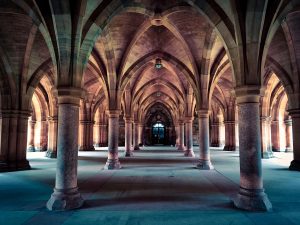
Things to do in Glasgow
/ / Kelvingrove Art Gallery & Museum: Massive museum with one of the largest art collections in Europe. Learn and see natural history, Renaissance art, artifacts from ancient Egypt, and art from famous painters like Vincent van Gogh and Salvador Dali.
/ / Glasgow Cathedral: A Scottish place of worship from 1197 with post-war stained glass windows. It was the only cathedral on the Scottish mainland to survive the Protestant Reformation of 1560.
/ / Scottish Food Tour: Or maybe a whisky and chocolate tour is more your vibe?
/ / Buchanan Street: Glasgow’s main shopping hub.
/ / Glasgow University Cloisters: The only time you’ll ever see me excited about going back to school. The cloisters inside the university halls are stunning and have been featured in many films and TV shows, including Outlander.
/ / Barras Market (weekends only): Long-established, weekend market with indoor-outdoor shops, vintage goods, and local products.
/ / Finnich Glen to Devil’s Pulpit Hike: A micro canyon of verdant green that’s carved by a crimson river, just outside of Glasgow.
Where To Stay in Glasgow
Native Glasgow is a central hotel inside a stunning Edwardian building with original 1906 features. The Glasgow Youth Hostel is a budget-friendly option close to the main attractions, and the voco Grand Central Glasgow is an iconic landmark in the city with touches of royalty.
Places to Eat in Glasgow
If you know me, you know I scoped out the coffee scene here, and can’t go without giving a few recommendations for my fellow coffee-loving folk: try Ocho, Zennor, and Copperbox Coffee for something fun.
As far as dining goes, my favorite place to start looking for places to eat is via the Michelin guide and the James Beard Foundation. Michelin stars are for fine dining, but few know that they also give out other awards for cocktails and other exceptional restaurants. A few that stick out in Glasgow are Margo, Ka Pao, and Celentano’s.
Day nine at a glance
/ Glasgow
Day 10 | Fly Home
Most flights to and from Scotland are in and out of Edinburgh International Airport (EDI), but coordinate your plans depending on where you fly out of. If you have a red-eye leaving tonight, it gives you plenty more time to linger around Edinburgh or Glasgow.
Remember that most hotels offer luggage storage services even after you check out, so if you have a later flight, you can take advantage of this. Make sure to check out my other Glasgow or Edinburgh recommendations throughout this blog so that you can maximize your time in either city.
10-Day Scotland Itinerary Overview
Here is an overview of what you’ll be exploring over your Scotland itinerary. Be sure to download the free map at the top of this blog post to help you map directions up to everything.
Day 1 | Edinburgh
Day 2 | Edinburgh
Day 3| Edinburgh to Isle of Skye
Day 4 | Isle of Skye
Day 5 | Isle of Skye
Day 6 | Isle of Skye to Glencoe
Day 7 | Glencoe
Day 8 | Fort William
Day 9 | Glasgow
Day 10 | Glasgow/Fly Home
How many days is enough in Scotland?
There are so many incredible things to see and do in Scotland that the minimum amount of time you should consider is 7 days. However, 10-14 is more ideal if you want to visit the main attractions and get off the beaten path. More is always merrier so you have more time to slow down and indulge in the country.
Where To Stay in Scotland
Unique or special accommodation is the cherry on top of any good itinerary. These are a few special places to stay around Scotland that would be worth considering for your trip. I highly recommend scoping out Airbnb as well because there are some seriously cool properties (like CASTLES!) you can stay in.
Riverbeds Luxury Wee Cottages | Right smack dab in the middle of the Scottish Highlands is this aesthetic nature escape complete with its own hot private hot tub. It’s on a private estate in Glencoe Valley and has all the luxuries for a few nights of zen in the forest.
Isle of Skye Rotunda | This is a unique, one-bedroom apartment that resembles a yurt with its rounded edges and moss roof. It’s just south of Portree, so it’s in a great location (away from crowds) on the Isle of Skye, but still close to the main sights. The property is particularly picturesque with views over verdant hills and valleys.
The Balmoral Hotel | This historic hotel opened in 1902 and has housed celebrities and royalty over that millennium. A stay here is a vacation in and of itself with all the amenities, Michelin-star chefs, and pristine rooms.
How To Get Around Scotland
Scotland is chock full of transport options, so even if you’re tackling a Scotland itinerary without a car, you don’t need to worry about how you’re going to get around. These are the most popular options for getting around the major cities and other areas.
Rental Car
The best way to get around Scotland is with your own rental car for complete freedom and control over your schedule.
If you opt for guided tours, you will be at the mercy of the masses and experience peak crowds everywhere you go and also miss out on some things, so definitely consider your own set of wheels.
Good to know | you don’t need a car when exploring the major cities of Edinburgh and Glasgow since they’re very walkable.
You don’t need much to get a rental car in Scotland, just a standard driver’s license. If your license is not in English, it’s best to get it translated to avoid hiccups. Some rental agencies require you to be at least 21 years old, otherwise you may be charged a young driver free. Finally, it’s required to have insurance for a Scotland car rental. If you have a travel credit card, you may already be covered depending on your policy.
Unless you’re going way off the beaten path in Scotland, the roads are well-maintained, so you do not need a high clearance or 4×4 vehicle.
It’s also good to know that they drive on the opposite side of the road in Scotland, so you may want to take your car for a test spin to get used to everything being left aligned.
Guided Tours
A great alternative to a self-drive Scotland itinerary is utilizing guided tours that leave from Edinburgh and Glasgow. A lot of the spots these tours hit are included in this itinerary, the only difference is that someone else will be driving. This is what I did on my first trip to Scotland and I found it a great way to see the country with piece of mind.
There are a variety of tour companies that will take you around the Scottish Highlands and the Isle of Skye for 3-5 days, with almost everything included. Some cover all your accommodation while some only cover a few nights and a handful of meals, so be sure to compare those things so you find the right tour for your budget.
This is usually much more expensive than doing it yourself, but it offers a huge piece of mind if that’s something you value when you travel.
An important thing to know is that many of these companies run similar tours, on the same schedule, so this means you’ll be arriving at popular attractions at the same time as everyone else. Now more than ever, crowding can absolutely change your travel experience, so this is something to weigh when booking a multi-day tour.
Guided tours from Edinburgh
/ / From Edinburgh: 3-Day Isle of Skye and The Highlands Tour: This is a classic Isle of Skye tour where you’ll pass by Stirling Castle, explore Glencoe Valley, and other famous spots like Loch Ness, Urquhart Castle, Eilean Donan Castle, and Cairngorms National Park. For an additional cost, you can join a whiskey tasting at Dunkeld.
/ / From Edinburgh: Isle of Skye and Hogwarts Express 4-Day Trip: Calling all Harry Potter fans, this tour is for you. It covers the main highlights of Skye (Glencoe, Loch Ness, Trotternish Peninsula, and more) plus the Jacobite Steam Train experience. While you’re exploring, there may also be an opportunity to join a wildlife cruise in Mallaig.
Guided tours from Glasgow
Some people choose to fly in and base themselves in Glasgow. If that’s the case for you, this city also runs some excellent tours.
/ / Isle of Skye 3-Day Small Group Tour from Glasgow: This classic tour is full of eye-candy in Fort William, the Isle of Skye, and the rest of the Highlands. Hit all the highlights like Glencoe Valley, Eilean Donan Castle, and Portree, plus Kilted Rock, Loch Ness, and other picturesque spots.
/ / From Glasgow: Scottish Highlands & Isle of Skye 5-Day Tour: Isle of Skye, Loch Ness, Loch Lomond, Kilmartin Glen, and Glencoe are highlights of this 5-day tour. It’s like a classic 3-day Highland tour but spread out over more time so you can explore more and pack more sights in.
Train
If you don’t have a car, the rail system in Scotland is a good way to get to major areas. However, I don’t recommend fully relying on it because it can only take you so far.
That said, Scotrail is the main choice for train travel in Scotland and they have a bunch of different ticket options and routes that go all over the country. Inverness, Oban, Mallaig, Glasgow, and Aberdeen are all popular destinations with frequent stops in smaller towns.
You can view the route information on their website to find out if train travel is right for your itinerary. It’s worth noting that if you choose to travel with this mode of transport, transit times will be significantly longer, which may impact what you’re able to see and do.
Bus
While you’re in Edinburgh and Glasgow, the bus is a great way to get to major checkpoints in the city. For shorter distances, each city is very walkable, as long as you wear comfortable shoes.
Lothian is the favored bus company in Scotland. You can purchase tickets directly from the bus driver when you board, but you have to have exact cash when doing this, so it’s best to have a contactless card or the bus & tram app. Tickets go as low as £2, so it’s an affordable way to get around.
Also, they have a journey planner tool you can use to get specific instructions to get to the bus stop, get on the correct bus and the estimated time frame you’ll depart/arrive. With this, it’s practically impossible to get lost.
Taxi / Rideshare
Taxis are the most expensive way to get around Scotland, but they do have their place if you’re having a late night out in the city.
Uber is also widely available across Edinburgh, Glasgow, and the rest of Scotland.
What is the best month to go to Scotland?
The best month to visit Scotland is typically the shoulder seasons, spring and fall, but every season has its draw.
For this itinerary, it’s best explored in good weather and I wouldn’t recommend using it during the winter months since the majority of the natural attractions are inaccessible or closed. However, it can always be altered to suit a winter trip.
I have a full guide on the best time to visit Scotland, so you can plan your trip around your travel style and preferences.
If you have any other questions about visiting Scotland, please reach out! Otherwise, browse my other Scotland guides to help you plan your trip:
Tips For Traveling Scotland On A Budget
Is the Isle of Skye Worth Visiting?
Where To Stay on the Isle of Skye
How To Get From Edinburgh to the Isle of Skye
Best Coffee Shops In Edinburgh

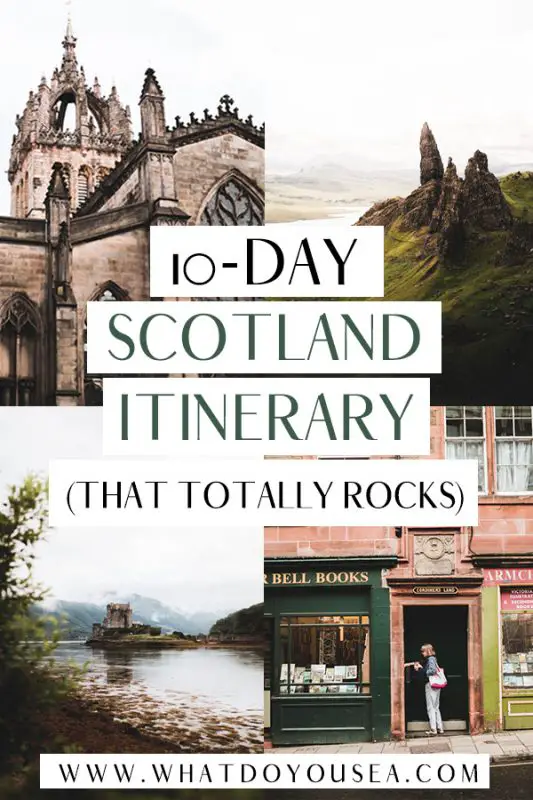
Did you find this guide for a 10-day Scotland itinerary useful? Save it for later on Pinterest!

Hello,
Where would you add a visit to Dean’s Village to this itinerary?
Hi Brooke, the best natural fits are days 1 & 10 depending on when your flight lands and departs, but you could consider getting up earlier the morning of the 3rd and visiting before you began driving to the Isle of Skye. Hope this helps! – Aaren
Such a thorough itinerary, thank you so much!!
So glad you enjoyed (:
This sounds amazing and a lot of places were already on my list, but how do I see them without a car? 🙁
There are bookable tours you can take through the highlands! I can recommend a company called “MacBackpackers”. They do a great job and you can see so much. If not a tour, check bus routes and see if there is a way you can use that alternative transport (: Best of luck!
Edinburgh is one my bucket list!
It’s an incredible city! (: You should definitely pay it and Glasgow a visit!
So much great info and your photos are gorgeous!
Thank you!! (:
LOOKS LIKE A DREAM COME TRUE! So good to know that you recommend 5 days for The Isle Of Skye. Scotland is for sure somewhere I want to go next year and will definitely refer back to this post!
It truly is!! I was there for three days and I still didn’t see everything that I wanted to! It’s such a magical place!
Great information on Scotland – Very helpful!
Thank you so much! I am glad you enjoyed it! (: