
Last Updated on February 8, 2026
Is the sky blue?
Yes, OF COURSE the Isle of Skye is worth visiting! It’s one of the most visited islands in Scotland for its unique geology, otherworldly landscapes, and whimsical connection to Scottish folklore.
However, whether the Isle of Skye is worth visiting depends largely on how much time you have in Scotland and how you prefer to travel.
Over the years, the isle’s popularity has increased tenfold, which is a lot of the reason why people think it’s “too touristy” now. This guide will answer your questions and give you practical tips, whether you’re stuck with a peak season visit or trying to decipher if it’s right for your trip at all.
The verdict: The Isle of Skye is worth visiting if you have enough time, flexibility, and realistic expectations about crowds. If you’re short on time or prefer fast-paced travel, Skye may not be the best fit for your Scotland itinerary.
Let’s discuss.
Please note that some links on my blog are affiliate links. If you choose to purchase through these links, I may receive a small commission at no extra cost to you. When What Do You Sea is supported in this way, you are helping me remain an independent travel blog where I can continue to create free and detailed guides. Read my full disclosure for more information.

25 Things to Know Before Visiting the Isle of Skye
Is the Isle of Skye right for you? Know these things before you make your decision.
How To Get To The Isle Of Skye
The Isle of Skye is the only island in Scotland that can be accessed by car, which is why it’s a popular choice for travelers.
But there are multiple ways to get there, and what you choose will depend on your interests and how much time you have.
You can access Skye by bridge or ferry
Yes, Skye is an island, but you can drive onto it thanks to the Skye Bridge, which connects the Kyle of Lochalsh on the mainland to Kyleakin on Skye.
You can also access it from two different ferry terminals.
The first is the ferry in Mallaig. It runs twice daily and spits you out in Armadale, in the southern part of the Isle of Skye. You can ride it as a foot passenger or bring your car.
The other option is the Skye Ferry in Bernera. It’s the last hand-operated turntable ferry in the world and it’s kept running by a group of community volunteers. It leaves from Bernera and takes you to Kylerhea, which is just south of Kyleakin.
The Skye Ferry is a bit out of the way and takes a little more time than the other two options, but it’s unique and well worth considering.
Can the Isle of Skye be done as a Day Trip?
Usually no. The Isle of Skye is not ideal as a day trip because it’s far from major cities, requires long drive times, and most attractions involve walks or hikes that shouldn’t be rushed.
It’s best enjoyed with at least one overnight stay. Otherwise, you’ll spend more time traveling than exploring.
Why Skye is difficult to do as a day trip
Because Skye has this title of being “unmissable” and a “must-see“, travelers will try to cram it into their itinerary in any way, shape, or form.
Skye is about three hours from Inverness and five hours from Glasgow and Edinburgh without any stops, one way. So driving from Inverness, Glasgow, or Edinburgh to the Isle of Skye for a day trip is easily a 14-18 hour travel day (and 10 of that is spent in the car).
It gets to a point where people are going just to say they went and cross a bunch of things off the list, which is not how anyone should experience Skye.
If you’re going to try for a day trip, travel from Inverness. It’s not worth it from Glasgow or Edinburgh.
What about guided day tours to the Isle of Skye?
There are plenty of guided day tours to Skye from Inverness, but you should know that they jam-pack the itineraries and most “stops” are actually speedy stops to get off the bus, grab a photo, and get back on.
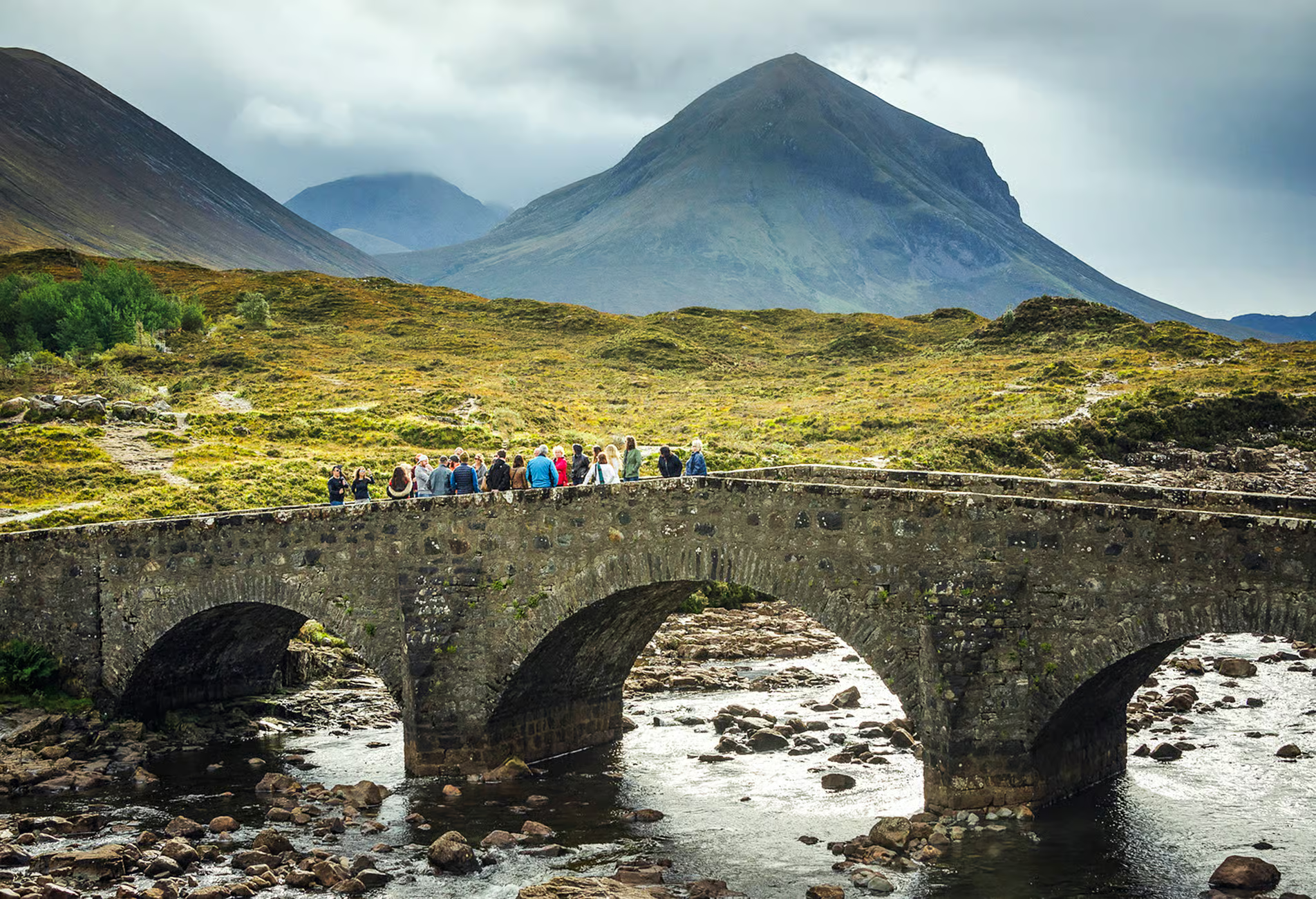
To put it into perspective, most tours I’ve seen include photo stops at the Old Man of Storr, but you can’t see the Storr from the car park. You must do the walk in order to see the entire rock formation, which a day tour usually doesn’t allow.
If I were to choose one, I’d pick this one. It’s a full-day trip from Inverness that makes only four meaningful stops that include three hikes. It will get your boots on the ground and won’t make you feel like you saw Skye as just a passing glance through a bus window.
Multi-day tours?
One of the most popular ways travelers see the Isle of Skye is done-for-you, multi-day tours that leave from Glasgow, Edinburgh, or Inverness.
I don’t personally recommend them, but I can acknowledge how they’re a good fit for a travel style different than my own. They’re convenient and can be a more affordable option for anyone wanting to get into the Highlands with a quick turnaround.
Or, honestly, for anyone who doesn’t want to drive on the left side of the road (can’t blame you there!).
If you like to dilly-dally when you travel, these aren’t for you.
My 3-Day Isle of Skye tour experience
I went on one of the three-day tours offered by MacBackpackers. They’re new to Get Your Guide, but one of the original tour companies for this kind of trip.
Let me start by saying I think these tours are great… For the right person. But here are some of my thoughts for you to chew on.
You only spend one true day on Skye. The first day of the tour is spent driving up to Skye, with stops along the way. The second day explores the Trotternish Peninsula, and the third day, you spend driving back to Edinburgh.
This is great because it allows you to see more around the country, but time was spent on things that could have used in other places. On the first day up to Skye, we did a short hike in Killicrankie, near Pitlochry. It was beautiful and all, but it would have been nice to get to Skye earlier and spend more time at some sights there.
You will constantly feel like you’re on a time crunch. On day two, we had an hour-long “photo stop” at the Old Man of Storr, which is very long for photos, but not enough time to complete the hike. I was the only one on my bus who made it to the top and back down, and I had to run down the trail to make sure I didn’t miss the bus.
Also, the guide was very transparent that if I didn’t make it back, he would have left me there.
Most meals are not included. Day one, you’re on your own for breakfast before getting on the bus, then you get a sack lunch on the bus ride up to Skye and have your choice of dinner somewhere in Kyleakin. Day two: free breakfast at the hostel (which was toast and jam), then we could “get lunch” during our one-hour stop in Portree, and then again opt for dinner somewhere in Kyleakin. The next day, you get toast and jam, then that’s it for the ride back to Edinburgh.
The guide (and the bus) can choose to skip things. A real downer if you’re stubborn and independent (like me). Depending on time and the interest of the rest of the people on the bus, the guide may choose to skip certain things or have the bus vote for what they want.
Which brings me to my last point…
Your guide is a matter of luck. It could have just been my guide that made the tour feel so… shallow? Hundreds, if not thousands of people take these tours and rave about them, so don’t mistake my preferences as all of these tours feeling this way.
I see a lot of people recommending these tours, while having not actually been on one. Going on a tour pales in comparison to doing a DIY tour, which is what most bloggers do.
I want to elaborate on my full experience in another blog post. It’s not that these tours are bad and under-deliver, but it’s important to know what to expect before you pay for the experience.
Do you need a car on the Isle of Skye?
If you’re not traveling with a tour company, you absolutely should have a car on the Isle of Skye.
Skye is best seen with your own rental car
The Isle of Skye is best explored with your own set of wheels.
This is what I’m doing for my second trip this coming summer, which will be a redemption from the last time I was there (on that 3-day tour).
Why drive yourself? You get complete control over your schedule, the things you want to see, and the time you arrive at those places.
All of the coach bus tours follow similar schedules on Skye and therefore arrive at the main locations at the same time. This typically falls anywhere between 9 a.m. and 5 p.m. This means buses full of people are stopping at the same places at the same time. Yikes.
With a rental car, you can travel outside of these hours. During peak season, the sun rises at around 5 a.m. and doesn’t set until 10 p.m. By either of these times, all the day trippers have left, and most others have settled into their accommodations for the night.
And, as if you needed any more convincing to get yourself a rental, you can see more things with the abundant daylight hours offered from May to September.
Can you get around Skye without a car?
It is possible to travel around Skye using public transport, but it’s very limited and doesn’t offer services to more remote places. Unless you’re spending more than a few days on Skye, I don’t recommend using public transport to get around.
What It’s Like To Drive On The Isle of Skye
Anyone with driving experience, left side or no, shouldn’t have any trouble getting around, but there are some things you need to know that are specific to the isle.
Know the rules of the road
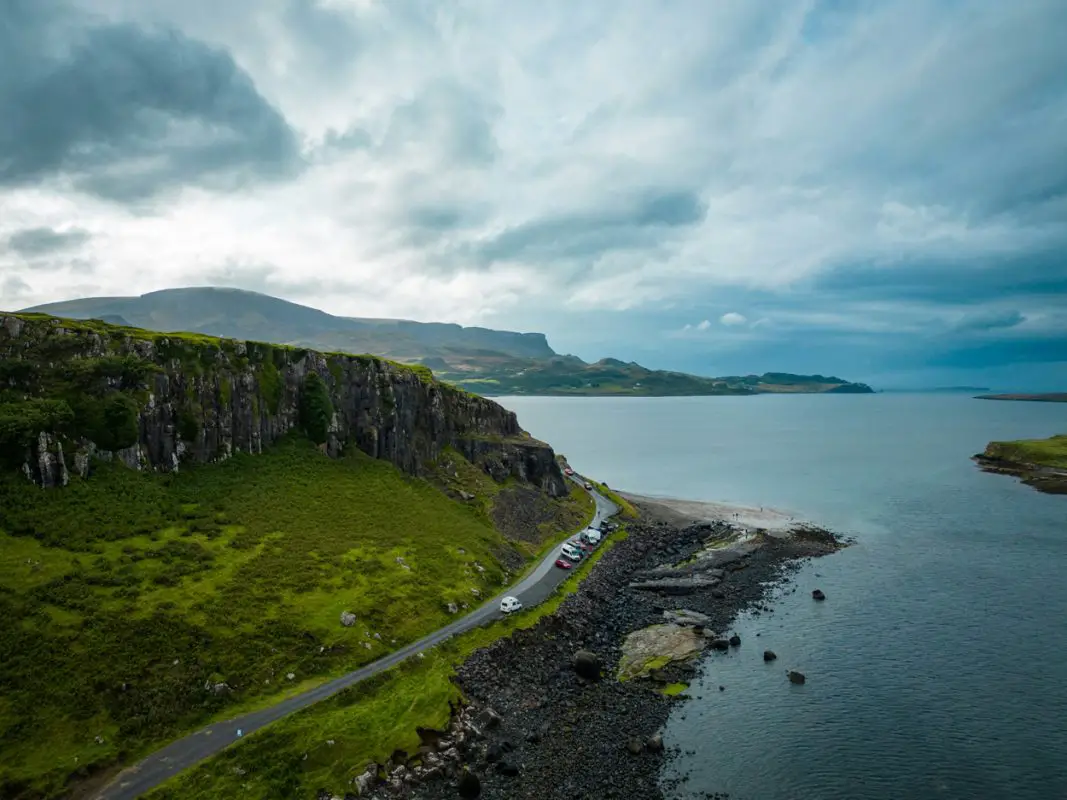
One-track roads. Driving on the left. Driving can get hectic on the Isle of Skye.
I’m going to write a whole blog post about driving in Scotland, but in the meantime, you must know these things to get around Skye safely:
Never park in passing places. Unfortunately, that epic view you see is not an excuse to pull off into a passing place for a photo. This is an epidemic across Skye, and it causes unnecessary jams in the flow of traffic.
Speed limits are in mph. Just so you don’t slow anyone down.
Familiarize yourself with road signs. Especially regarding speed limits.
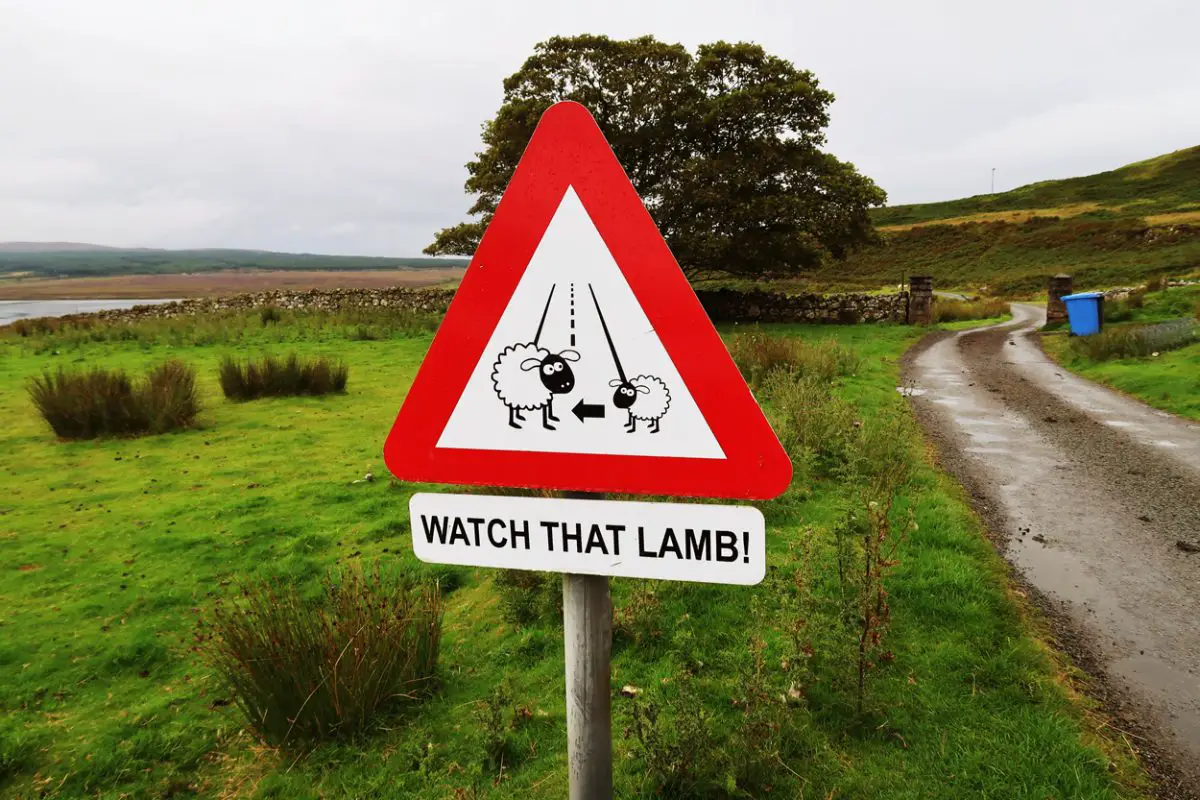
Don’t speed. A universal rule of the road. Think of the sheepies.
Watch out for livestock. Sheepies and coos often utilize roads, too, so be mindful of anything furry making its way across. This also goes for cyclists and motorcyclists using the roadways.
Only use designated parking places. Parking lots at the main tourism spots fill fast, especially in the late mornings. This doesn’t mean you can use the sides of the road for makeshift parking. Either wait for someone to leave or come back at a better time.
Don’t hug the center line. Many drivers are new to the left lane and therefore hug the centerline very closely. Doing so can cause you to clip the mirrors of other drivers, so be cautious and stick to the middle of the lane.
Practice reversing. While there are plenty of passing places for main roadways, there will come a time when you or another driver may pass one and need to reverse to make room.
Know how to navigate one-way roads. Patience is key.
Be self-aware. AKA knowing when there is a line of cars behind you begging for you to make a turn or pull off somewhere. Do not hold up traffic, and if you are, find a safe place to pullover so they can pass you.
When is the best time to visit the Isle of Skye?
Your tolerance for weather and crowds will be the two determining factors for when the best time to visit Skye is.
The Isle of Skye is best traveled during the shoulder seasons
Fall and spring are the best times to visit the Isle of Skye. Orange, red, and gold tones drench the isle in autumn, and combined with the fact that crowds have thinned, it’s an irresistible time to go. Peak colors typically happen from late September through October.
If you don’t want peak summer crowds, but still want Skye’s famous verdant green rolling hills, visit in the springtime from late April to May.
Winter is the least popular time to visit Skye, but with the right gear and a good attitude, Skye is just as beautiful with a blanket of snow. Winter is in full swing from December to February, that’s when you can expect the highest chances of snow.
Storefront and restaurant hours drastically reduce outside of peak season
If you’re traveling to Skye anytime from late April to late October, you can expect almost everything to be open and accessible.
When you travel outside of that time, from November to the end of March, that’s when restaurant hours dwindle, some shops close, and other attractions are inaccessible.
Some examples are that Birch Cafe, a trendy spot in Portree, is only open on Saturdays in the winter months. Dunvegan Castle is closed completely during this time, and you can expect small, locally owned shops to be closed for the season, too.
Visiting in the winter requires a little more self-servicing, but it can be fruitful for the independent traveler.
Peak season is from June through August
Travelers beware: the Isle of Skye is bursting at the seams with tourists from June through August.
Peak season is nothing to be taken lightly. Skye suffers brutally from overtourism during this time of year.
You can expect tours, accommodations, ferries, and car rentals to be fully booked during this season. It’s nearly impossible to travel to the Isle of Skye spontaneously because of this. The framework of your itinerary (everything I listed above) should be planned and booked at least 6 months in advance.
But even if you score the dream place to stay, once you get there, you’ll battle with all the other tourists for parking and getting around on the congested, one-track or two-lane roads.
However busy you think it will be, double, or maybe even triple that. If any of that sounds like a nightmare (it should), plan your trip during the spring or fall.
It doesn’t have the capacity for the number of visitors it receives
A huge part of why summer on the Isle of Skye is so jammed is that facilities are extremely limited.
There are no major chains on the island, and all the stays are small B&Bs, hotels, and guesthouses. Tours can only fit so many, and so the entire island, for months out of the year, operates at 100% capacity. And that doesn’t even begin to factor in day trippers.
This is another reason why it’s better to visit during the shoulder seasons, to help tourism spread out throughout the year, rather than being squeezed into a small window.
Plan ahead
If you’re visiting Skye anytime between May and September, it’s imperative that you make plans far in advance.
Secure accommodations and tours at least 6 months in advance
Year after year, more and more people get the memo to book early if they’re serious about visiting the Isle of Skye.
As I write this, it’s January, and for July travel dates the same year, nearly 90% of all accommodations are booked out in Portree. I’m actually visiting Scotland this year and made all my reservations back in October and November to have the best selection, so I would argue that the further out, the better.
Some people go as far as to book a full year in advance of their travel dates. It’s cutthroat out here. Book as soon as you know you’re going to Scotland.
Base yourself in the right hub
The most popular place to stay on the Isle of Skye is Portree.
It’s the largest village on the isle, and it has a lot of the best restaurants and shops. Because of that, all the accommodation options in or near the village are the first to get booked out. The next two that get booked are Broadford and Dunvegan.
As options dwindle, travelers will scramble and book just about anywhere on the isle just so they have a place to stay. But they underestimate the size of Skye, and therefore how long it will take to get around.
I recommend using Google Maps to save all the places you want to see on a map, and then choosing your accommodation from there. This is so you don’t end up an hour or two drive one way away from everything you wanted to see.
Book your dinner plans in advance
This tip isn’t as strict as others, since the time of year you’re traveling and what food you have a palette for play a huge role in this.
First, this tip is specifically for travelers who desire to eat at restaurants like The Three Chimneys or Loch Bay. There are plenty of casual takeaway restaurants on Skye that don’t require reservations, so don’t feel like you have to have something secured to eat dinner.
There are limited places to dine (formally) on the Isle of Skye, and therefore, from May to September, if you plan to dine out for meals, try to have something reserved in advance. This is especially true if your accommodation isn’t self-catering.
You can expect to have the most trouble in Portree, Broadford, and Dunvegan, but you don’t need to secure plans too far in advance. Usually, restaurants are booked out a few days ahead, so in the weeks leading up to your trip, scout around and see what looks good/if reservations are starting to fill.
If you’ve already fleshed out your Isle of Skye itinerary, finding restaurants near the activities you have planned shouldn’t be too much of a headache.
As a backup, have snacks and water in the car in case the wait is long at peak mealtimes.
Don’t underestimate how big the Isle of Skye is
Another common mistake travelers make is cramming their itineraries with everything they want to see and do while on Skye.
Regardless of how long you’re there, know you won’t be able to see it all. Give yourself some breathing room to stop and take everything in at the places you visit.
Skye is more expensive than the mainland
Because of Skye’s remote nature, gas, groceries, and accommodations are all more expensive compared to other locations around Scotland.
Cell signal can be spotty
You can expect to have a decent signal in major hubs of Skye like Portree and Broadford, but in other areas, you can have fine coverage, walk a little way up the road, and have none.
Signal is spotty and unreliable, so to avoid hiccups, have Google Maps downloaded to your phone.
EE has the most reliable coverage around Skye. If you’re traveling with an eSIM, this one connects to the top four cellphone providers in the UK, so you will connect to whichever one has the strongest signal in the area.
Flexibility is crucial when visiting Skye
I mentioned before that facilities are severely limited compared to the number of people who visit here every year.
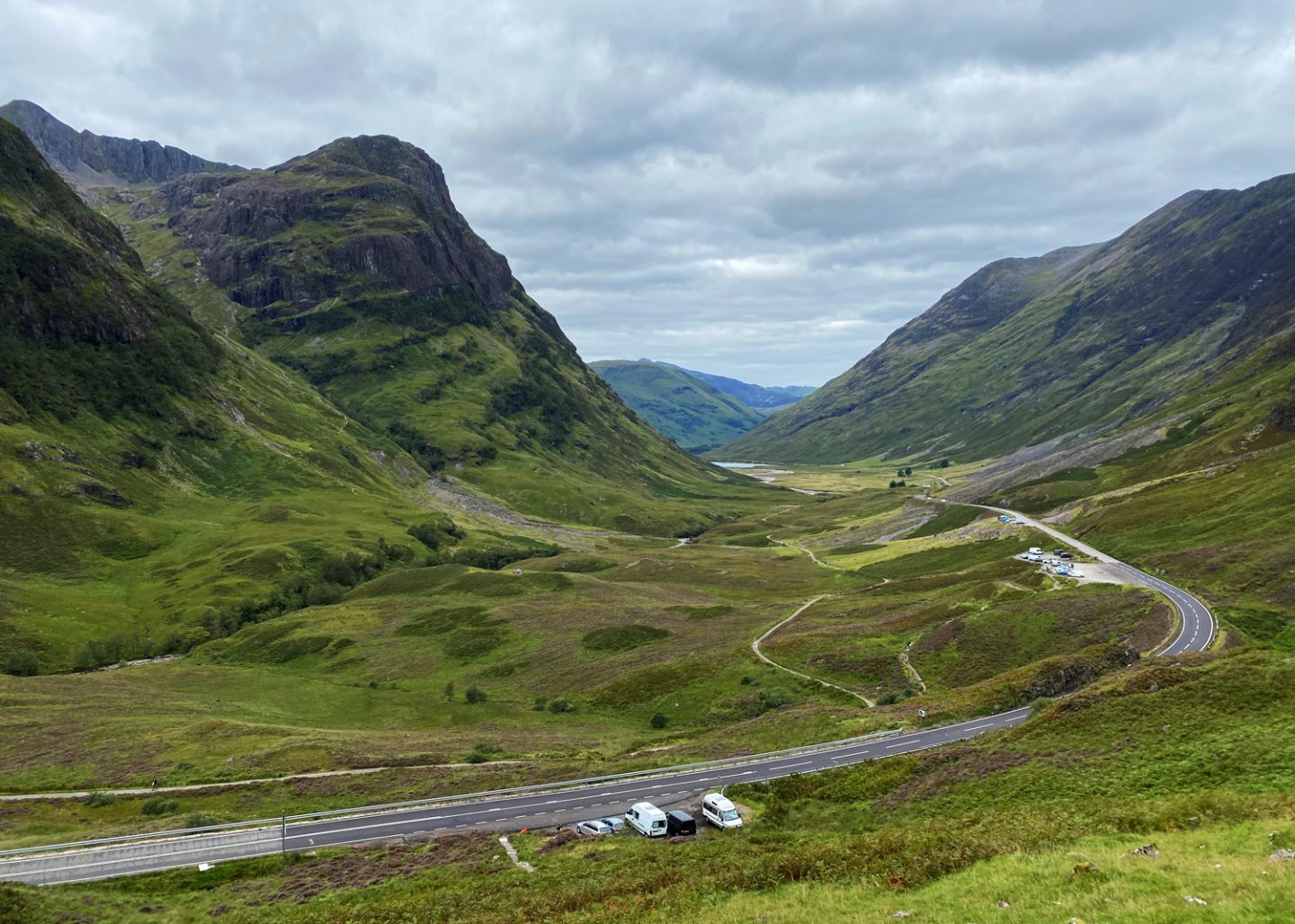
In peak season, parking lots are overflowing, and depending on when you drive, roads will be backed up with motorhomes and other travelers. Especially on one-track roads.
It’s vital that you can change plans and have a backup for when there is no parking or if something is delayed. Of course, you can combat this a bit by getting up early and exploring late, but everyone is bound to be inconvenienced at some point.
Flexibility will help prevent disappointment and keep spirits high.
Be prepared for rain
By now, we should all know that Scotland is not known for clear sunny skies in any season.
What to pack largely depends on what you’re doing, but given that all of Skye’s main attractions are outdoors and require at least a short walk or hike to get to, you at least need a proper raincoat and waterproof shoes.
And no, one of those $1 plastic ponchos is not gunna cut it.
If you’re doing any hikes longer than 4-5 miles, I would also recommend dry pants. If you don’t already own those, it doesn’t need to be an extra expense just for this trip, but do know you may get soggy.
Beware the midges
Every summer, a reign of terror blankets the north and western areas of Scotland. Wanted: the midge.
Midges are small flies that travel in swarms near warm and wet places. Imagine being swarmed by bees, but replace the bees with teeny tiny flies that bite like mosquitoes. It’s like that, but a little more biblical.
They’re known to haunt travelers during the prime summer months from June to August. They start to spring up in May and die off near the end of September.
You can avoid them by sticking to the east coast of Scotland during the summer months, visiting during the shoulder season, buying good insect repellent, and packing an ultra-fine mosquito head net in your luggage. When you arrive in Scotland, buy Smidge. It’s the best defense against these little assholes.
Also, they’re attracted to dark moving objects and CO2, so as long as you don’t move or breathe, you’ll be fine (jokes!!!).
Have a spare day or two added to your itinerary
This isn’t feasible advice for every traveler, but if you can manage, I recommend it. No season is immune to bouts of rain, and by having an extra day on Skye, you can be flexible if your activities get rained out.
Plan for it to rain every other day on the Isle of Skye during the summer months, and increase it gradually for the other seasons. Three weeks of the month are rainy by the time winter rolls around. Sheesh.
How To Experience the Isle of Skye Without Crowds
Despite its popularity, it is possible to travel to the Isle of Skye without the crowds it’s so famous for. First, travel in the shoulder or off-seasons from November to April, then do these things.
Hiking is the best way to see Skye
You’ll be surprised by how many travelers treat Skye’s main points of interest as photo stops.
Places like the Quiraing and the Neist Point Lighthouse are prime examples of this. They both offer panoramic viewpoints, and because of that, people snap a photo and are on their way. But both of these spots have hikes that will take you further into the vista, or through a new area entirely.
Choosing to do the hikes (also called walks) at sites like these puts you at a major advantage because you can ditch the bulk of the crowds. If a spot you’re visiting has the opportunity to hike a little, take it.
Look for offbeat locations
Most people who visit the Isle of Skye tend to visit the same main locations, which leaves much of the isle left to be uncovered.
The good part about this is that it makes it relatively easy to avoid all the congestion. The Cuillin Mountains are rife with secluded hiking opportunities; the Sleat Peninsula has its own set of remote views; and the Isle of Raasay is a worthy day trip from Broadford.
What can you uncover apart from what you’ve been told you “need to see” thus far? Whatever it may be, it will be the highlight of your trip.
Respect the land and local communities
The most important thing you can do while visiting the Isle of Skye is to respect the land and the locals.
When travel destinations get as popular as Skye is, it brings in more people who break rules and don’t care about regulations. This is why you see litter on trails, cars parked on the sides of roads, and natural areas that have been trampled due to higher foot traffic.
Leave places better than how you found them, stick to designated walking trails, don’t trespass on private property, don’t feed wildlife, and please, just don’t be an asshole.
So, is the Isle of Skye worth visiting?
For the right traveler, absolutely.
When it’s worth it
If you can spend at least two full days on the Isle of Skye, have the flexibility with your own schedule, and don’t mind the potential for crowds and congestion, Skye is worth it.
When you should skip Skye
If going to Skye feels forced, that’s when you know it’s not right for you. And trust me, you’ll know.
If you’re planning a last-minute trip in the main tourism season, your entire Scotland itinerary is five days or fewer, or if you’re a fast-paced traveler looking to check things off a list, the Isle of Skye is not for you.
If you fall in any of these categories and are patient, okay with navigating peak season crowds, and enjoy fast-paced travel, you can most definitely have a good trip. It will always be what you make of it, and the most important thing is to stay true to your own travel style and what you value.
Worthwhile alternatives to Skye
There’s more to the Scottish Highlands than just Skye, and trust me, they’re all begging for more foot traffic.
If you aren’t interested in crowds, or don’t have the time to go to Skye, consider visiting the Isle of Arran, going hiking in the Cairngorms National Park, or doing any of the great day trips from Edinburgh.
If you have any other questions about visiting Scotland, please feel free to reach out! Otherwise, have a look at my other Scotland guides to help you plan your trip:
46 Valuable Scotland Travel Tips
Tips For Traveling Scotland On A Budget
How To Get From Edinburgh to the Isle of Skye
Best Coffee Shops In Edinburgh

Don’t be shy! Save these tips for the Isle of Skye to your Pinterest board for later: